
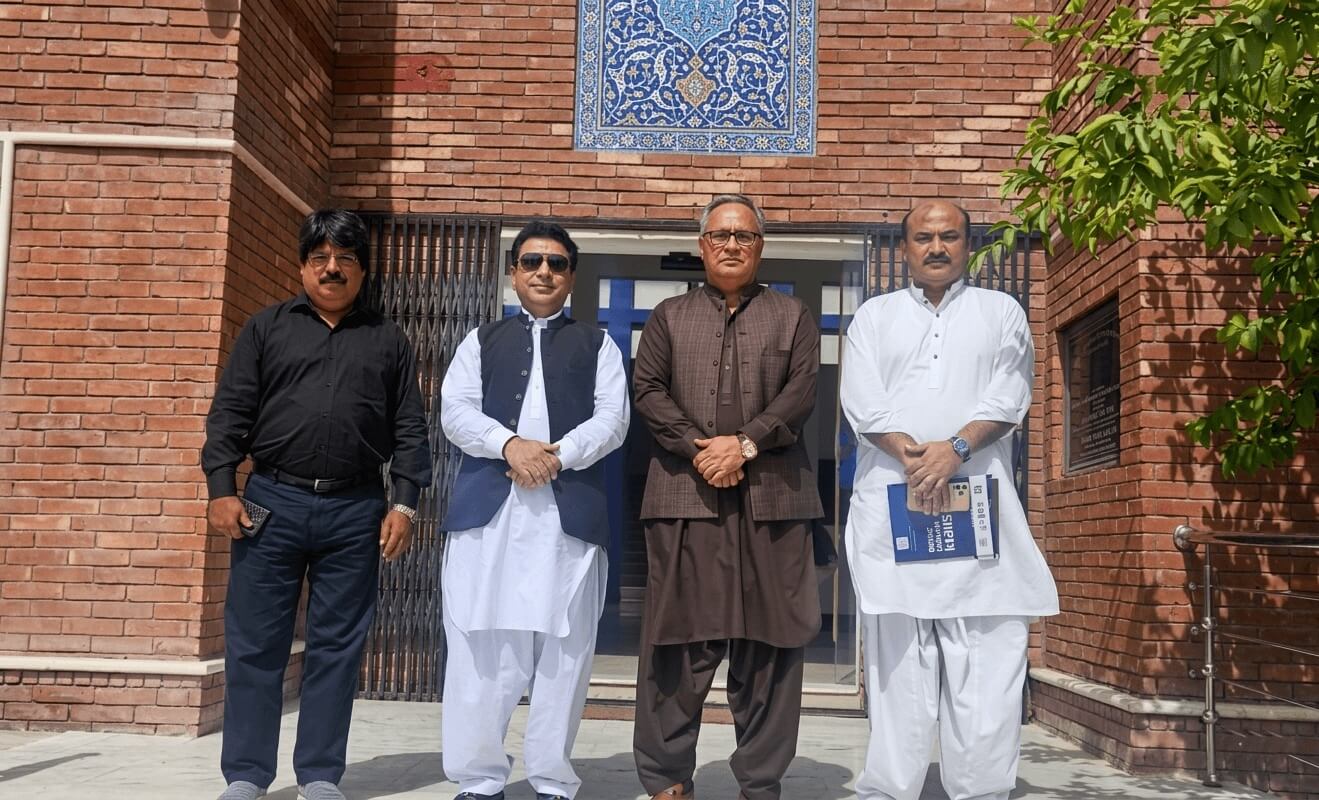
On the date 7th April, 2026, the Abdul Majid Bhurgri Institute of Language Engineering (AMBILE) had the privilege of welcoming a distinguished delegation comprising eminent intellectual Shoukat Ujjan, Mukhtiar Ahmed Abro, and Dr Sher Mehrani on 7th April 2026. The visit reflected a strong convergence of literary excellence, administrative leadership, and institutional vision for the advancement of the Sindhi language.
The delegation was warmly received by Amar Fayaz Buriro, Director of AMBILE, who provided an overview of the Institute’s mission, strategic direction, and its pioneering role in integrating the Sindhi language with modern technological frameworks, particularly in Artificial Intelligence (AI) and Natural Language Processing (NLP).
A detailed presentation was delivered by Rabail Aziz, highlighting the Institute’s accomplishments, ongoing initiatives, and future roadmap. Key projects presented included Bhittaipedia, a comprehensive digital encyclopedia on Shah Abdul Latif Bhittai, and the development of Sindhi WordNet, aimed at structuring linguistic relationships within the Sindhi language.
The delegation was also briefed on AMBILE’s cutting-edge work in Sindhi speech technologies, including Text-to-Speech (TTS) and Speech-to-Text (STT) systems, alongside various AI-driven tools designed to enhance Sindhi language accessibility across digital platforms.
During their visit, the guests toured the AMBILE Language Laboratory and Recording Studio, where they observed ongoing recording sessions for AI model development. These sessions include the creation of high-quality voice datasets and linguistic corpora essential for building robust Sindhi language models.
The distinguished visitors highly appreciated the visionary initiative of the Culture, Tourism, Antiquities and Archives Department, Government of Sindh for establishing AMBILE as a unique institution dedicated to the preservation, promotion, and technological advancement of the Sindhi language. They acknowledged the Institute’s significant contributions toward positioning Sindhi within the global AI ecosystem.
The visit concluded with a shared understanding of the importance of continued collaboration between academic, literary, and governmental institutions to further strengthen the linguistic heritage of Sindh through innovation and technology.