
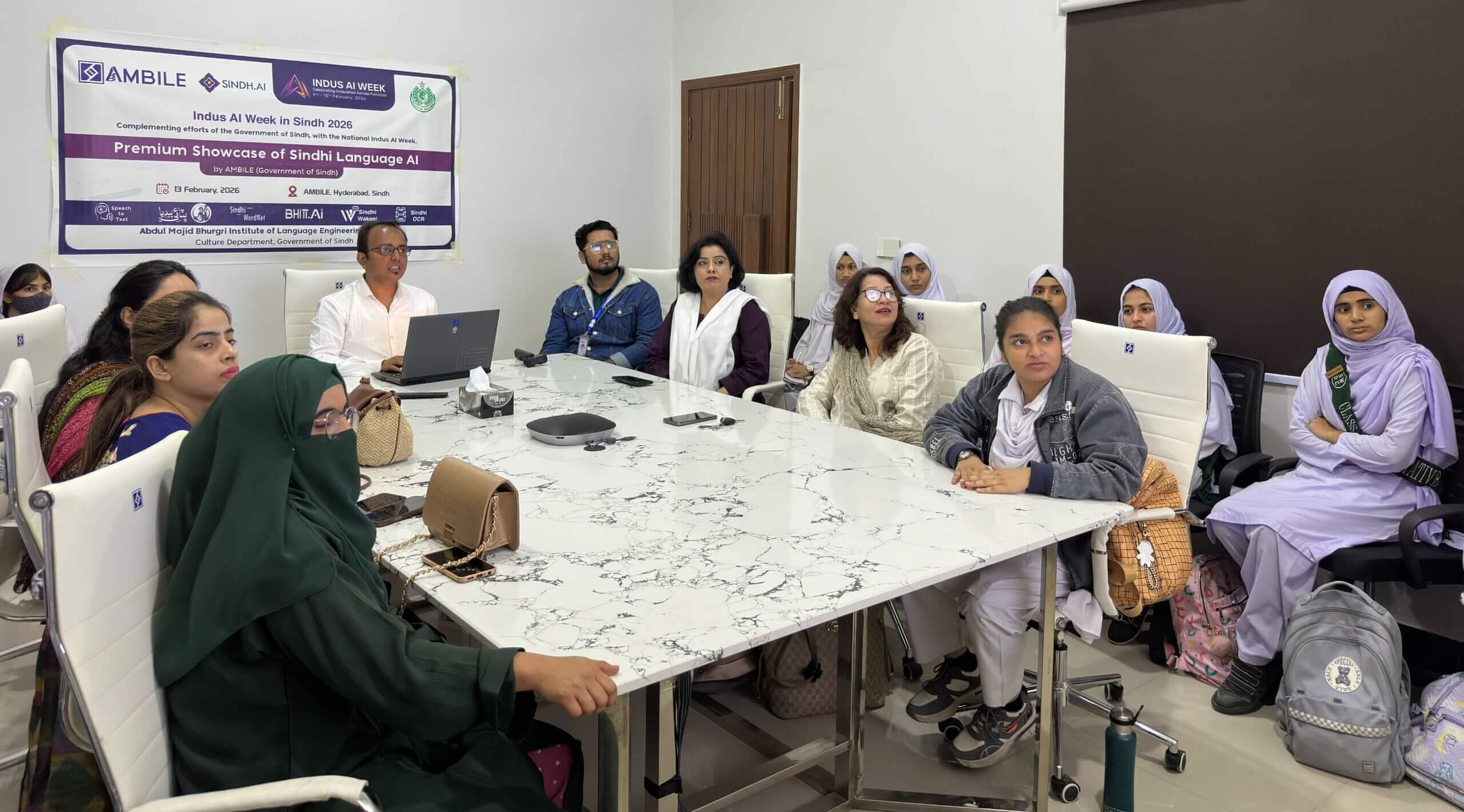
On Friday, 13 February 2026, the Abdul Majid Bhurgri Institute of Language Engineering (AMBILE), Hyderabad, operating under the Culture, Tourism, Antiquities & Archives Department, Government of Sindh, organized a workshop-cum-seminar as part of the province-wide observance of Indus AI Week in Sindh 2026. The event aimed to translate the national vision of Artificial Intelligence into practical awareness and institutional readiness at the grassroots level, with special emphasis on indigenous languages and their place within the evolving AI ecosystem.
The workshop hosted a delegation from Government Girls Degree College (GGDC), Kotri, comprising twenty students and five faculty members. The session was further enriched by the presence of noted writer and poet Mr. Zarab Hyder, educationist Ms. Saima, and social development activist Mr. Hasnain Raza, whose contributions highlighted the intersection of technology, language, and society.
The proceedings began with an introductory briefing on the mandate and ongoing initiatives of AMBILE as a public-sector institution working in language engineering, digital preservation, and Artificial Intelligence for the Sindhi language. Participants were introduced to the growing global relevance of AI across education, governance, research, and public services, and the need to ensure that indigenous languages remain integral to this transformation.
The technical segment commenced with presentations and live demonstrations of AI platforms developed by AMBILE. Mr. Rabail Aziz Solangi, AI Engineer, introduced Bhitt.AI—an intelligent assistant designed to help users explore the life, philosophy, and poetry of Shah Abdul Latif Bhittai—along with Bhittaipedia, a multilingual research and knowledge platform. He also demonstrated Wakeel.Sindh.AI, an AI-based legal assistant providing Sindhi-language access to legal information. He emphasized that Artificial Intelligence is a human-driven tool meant to assist and enhance human capability, not to replace intellect, creativity, or judgment.
Mr. Abdul Razaque Mangrio, AI Engineer, led an interactive discussion, responding to queries from students and faculty about the functionality, scope, and future potential of AI technologies. He highlighted how AI can support governance, research, and public services while remaining dependent on ethical oversight and human direction.
Ms. Manzar Aziz, Data Engineer, conducted a practical orientation session on the effective use of AI assistants and the importance of structured prompting. Participants were guided on how thoughtful prompt design improves AI outputs and supports learning, research, and productivity, reinforcing the idea of AI as a collaborative knowledge tool.
Mr. Abdullah Memon, Web Engineer, presented the Sindhi WordNet project and explained its contribution to lexical development and language modeling. He discussed foundational linguistic processes such as lemmatization and part-of-speech tagging and their importance in building robust AI systems for the Sindhi language.
An interactive engagement session followed, where students and faculty participated in group discussions on the application of AI in education, everyday life, and cultural preservation. Participants explored how AI can support the documentation of Sindhi folk wisdom and the integration of local knowledge into language models. The hands-on interaction allowed students to practice prompt formulation and actively engage in dialogue on AI learning pathways.
The visiting delegation also toured AMBILE’s studio, where voice recording for Sindhi speech technologies is underway. Participants observed dialect-based recordings and were introduced to ongoing work in speech-to-text and image-processing technologies, linking theoretical understanding with real-world research and development.
Led by Prof. Hamida Mirbahar, the delegation from Government Girls Degree College Kotri appreciated the initiative and expressed interest in continued collaboration. The college indicated its intention to host a similar workshop and invite the AMBILE team to further guide students and faculty. Participants emphasized the importance of expanding such initiatives across educational institutions to build awareness of technological advancements and encourage responsible engagement with AI.
A reflective session facilitated by Ms. Manzar Mirbahar from the AMBILE team encouraged participants to consider their role in contributing Sindhi language data for AI platforms. The discussion underscored the importance of academic collaboration, student participation, and community involvement in building sustainable language-based AI ecosystems.
The workshop concluded with a reaffirmation that Artificial Intelligence is fundamentally a supportive technology designed to assist humanity in knowledge creation, governance, and innovation. The AMBILE team expressed gratitude to the visiting delegation and reiterated its commitment to promoting ethical, inclusive, and culturally grounded AI development in Sindh.
The event successfully enhanced awareness, strengthened institutional linkages, and encouraged students and educators to engage actively in the emerging domain of language-based Artificial Intelligence. It reinforced the broader vision that AI becomes truly impactful when it communicates in the language of the people and contributes to the preservation and advancement of their cultural identity.